Why the robes are maroon
Saffron belongs to another Buddhism entirely. The colour of a robe tells you which Himalaya you are standing in, and most travel writing gets it wrong.
Search for images of Buddhist monks and you will mostly find saffron orange. Arrive in Bhutan and you will see almost none of it. The robes here are deep maroon, close to dried blood, and the difference is not aesthetic.
Two traditions
Theravada Buddhism, practised in Thailand, Myanmar, Sri Lanka, Cambodia and Laos, dresses its monks in saffron and ochre. Vajrayana Buddhism, the tradition of Tibet, Bhutan, Ladakh, Sikkim, Mongolia and parts of Nepal, uses maroon. Bhutan is emphatically the second.
Why maroon
The practical explanation is that madder root and local dyes were what the high Himalaya had. The doctrinal explanation is that robe colour was fixed by monastic code in each region and then held. Both are probably true. What matters is that it has been maroon here for centuries and it signals a whole lineage.
Get the colour wrong and you have placed Bhutan in the wrong half of Asia.
What else follows from it
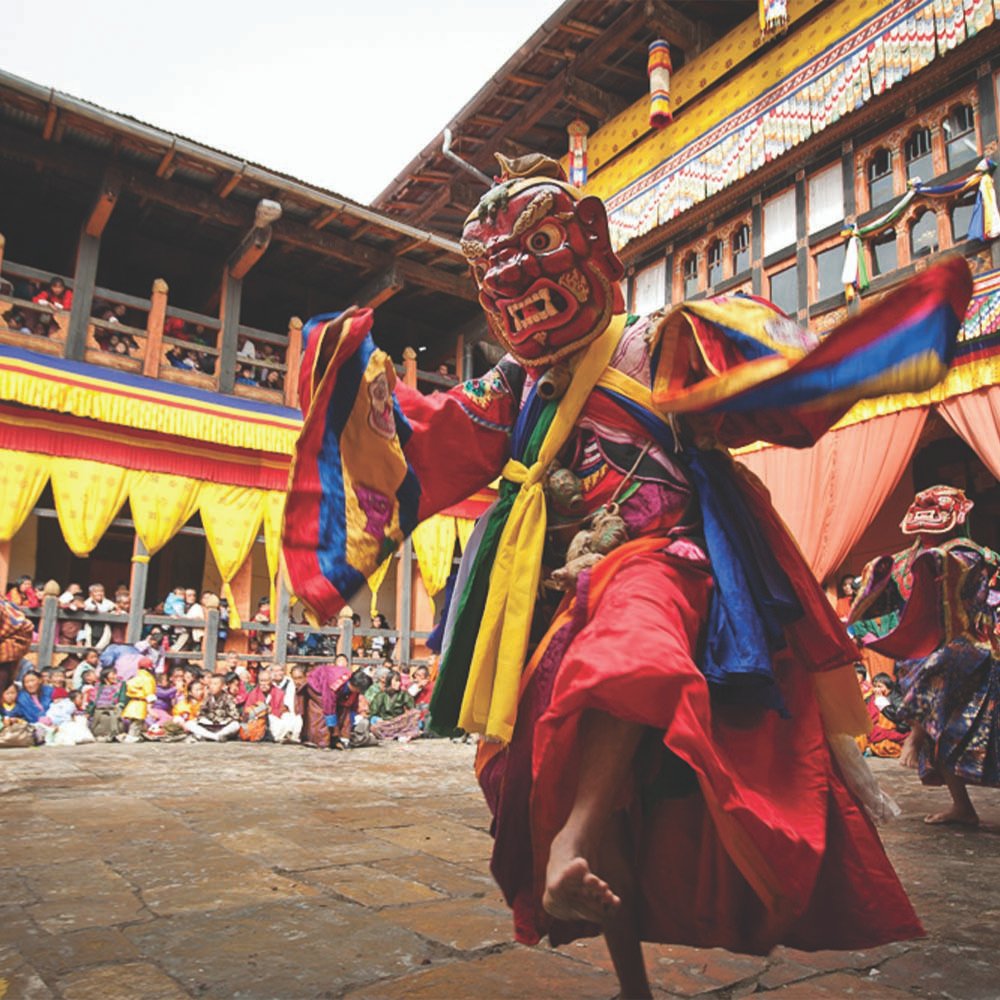
Vajrayana is why Bhutan has Guru Rinpoche rather than a purely historical Buddha at the centre of its festivals. It is why there are tantric deities in the wall paintings that visitors sometimes find alarming. It is why the mask dances exist at all. Cham is a Vajrayana form and has no Theravada equivalent.
A small thing worth carrying
Noticing the colour is a shortcut into everything else. When you see maroon in Ladakh or Sikkim, you are looking at the same lineage, the same texts, and often the same festivals under different names. It is one religion stretched along a mountain range, and Bhutan is where it was least interrupted.
One tradition, three destinations.
Bhutan now. Ladakh and Darjeeling from 2027, the same Himalaya, the same lineage.
Design Your Journey→A boutique travel company creating private journeys through Bhutan, Ladakh and Darjeeling.