
Understanding Tshechu
A Tshechu is not a performance arranged for visitors. It is a religious obligation, several centuries old, that visitors are permitted to attend.
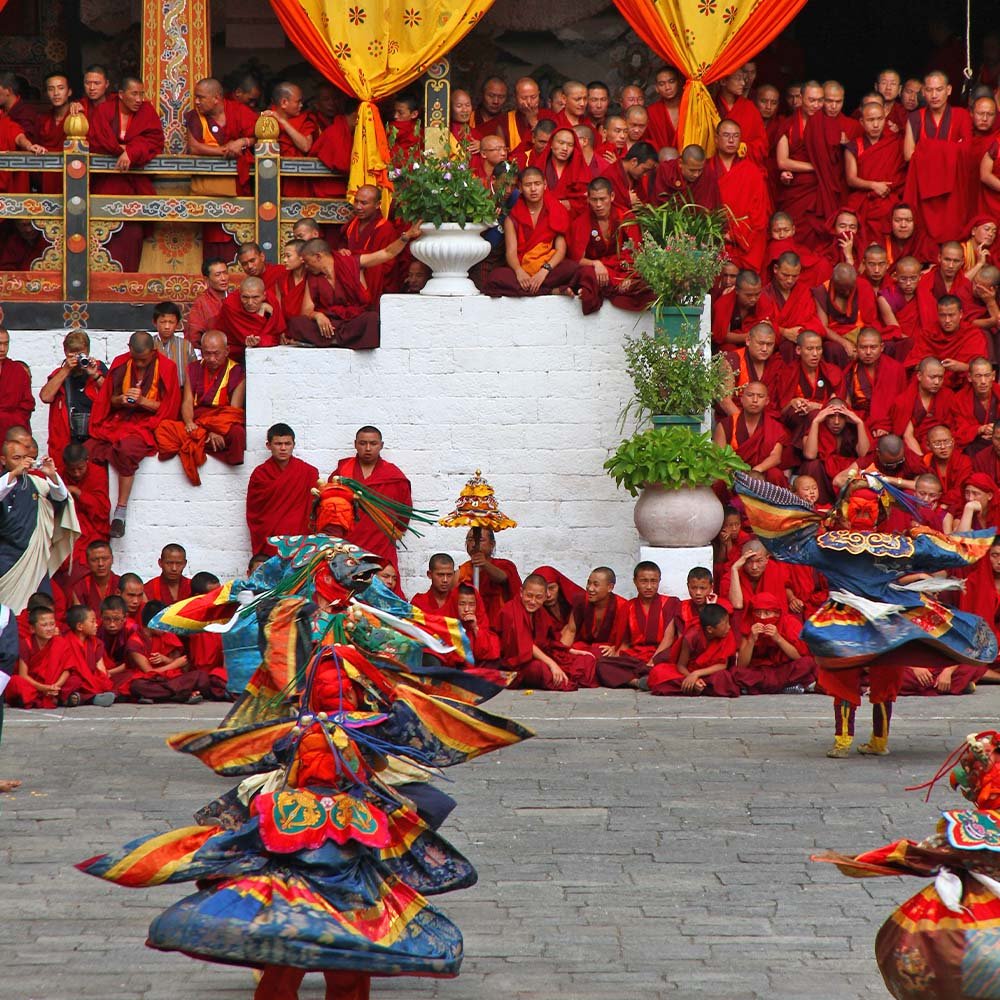
Tshechu means “tenth day”, the tenth day of a lunar month, held in honour of Guru Rinpoche, the eighth-century master credited with bringing Buddhism across the Himalaya. Nearly every district holds one, usually in the courtyard of its dzong.
What the dances depict
The Cham are masked dances performed by monks who train for years. They are not decorative. Each sequence enacts a teaching: the eight manifestations of Guru Rinpoche, the judgement of the dead, the four guardian kings of the directions. Watching without knowing what is shown is like attending an opera in a language you do not speak, striking, but half received.
The atsara
The clowns in red masks are not comic relief. They hold ritual licence to mock, including to mock the sacred, and their presence is what allows an intensely serious event to stay a community gathering. They also manage the crowd, which is a more practical role than it looks.
Families arrive in clothes kept for this. Attending is an act of merit, not an outing.
The Thongdrel
The largest festivals end with a thongdrel, an appliqué silk thangka several storeys high, unrolled against the dzong wall before dawn and rolled away before direct sunlight touches it. The word means “liberation on sight”. It is why people time entire journeys around a single morning.
How to attend well
Dress modestly, shoulders and knees covered. Photography is permitted in the courtyard but not inside temples, and never of the altar. Sit where your guide suggests. The seating is not arbitrary. Arrive early: by mid-morning the courtyard is full and the atmosphere shifts from ceremony to something closer to a sacred fair.
Dates move
Because the calendar is lunar, dates shift each year and are confirmed only months ahead. This is the one thing in a Bhutan itinerary that cannot be adjusted.
Time a journey to a festival.
Tell us which one draws you and we will confirm dates as they are announced.
Design Your Journey→A boutique travel company creating private journeys through Bhutan, Ladakh and Darjeeling.