
How to read a dzong
They are not castles and they are not museums. A dzong is a working fortress, monastery and district government at once, and knowing that changes what you see.
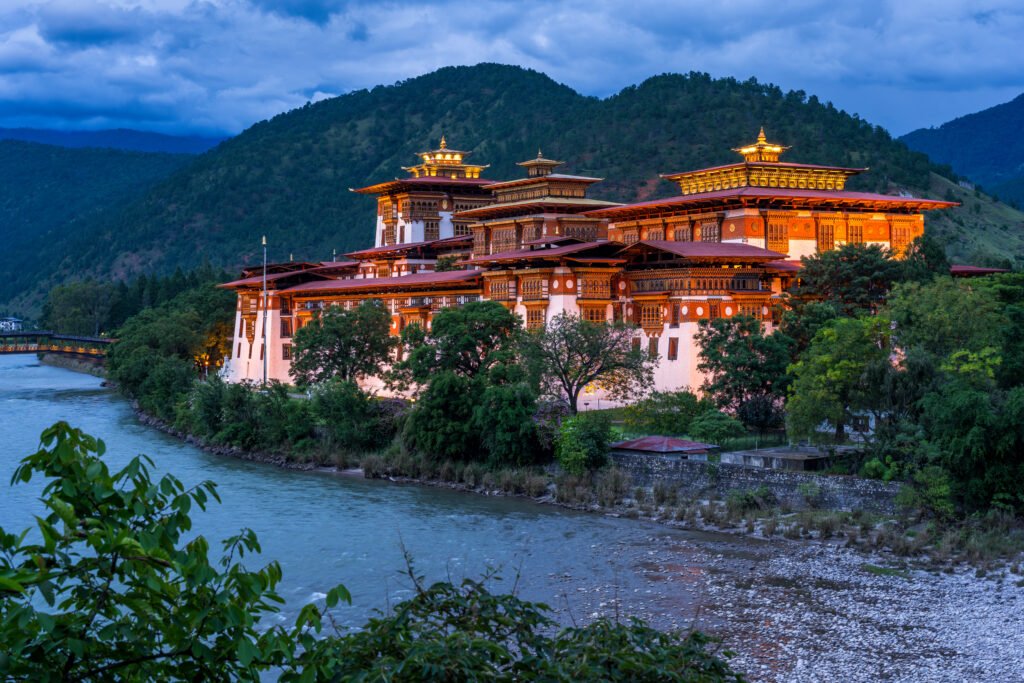
Every valley of consequence in Bhutan has a dzong. They are the largest buildings in the country, whitewashed, sloping inward as they rise, and built entirely without architectural drawings. The design is held by a master builder and passed on.
What they were for
Zhabdrung Ngawang Namgyal, who unified Bhutan in the seventeenth century, built them as a defensive network against Tibetan invasion. Their placement is strategic: Punakha at the confluence of two rivers, Trongsa astride the only east–west route, Paro guarding the approach from the south.
How they are divided
Inside, a dzong is split in two by a central tower called the utse. One courtyard is monastic, housing monks who live and study there. The other is administrative, holding the district court and government offices. Both are in daily use, which is why visiting hours are restricted. People are working.
You are not walking through history. You are walking through an office and a monastery that happen to share a wall.
What to look for
The four guardian kings painted at the entrance, one for each direction. The wheel of life beside them. The absence of nails anywhere in the structure. And the wooden phalluses on farmhouse walls nearby, which are protective rather than comic and connected to the Divine Madman.
Etiquette
Shoulders and knees covered. Shoes off before entering temples. Photography is usually fine in courtyards and never inside shrines. Walk clockwise around religious structures, chortens, prayer wheels, the building itself. Your guide will not always say this out loud, so it is worth knowing.
See them properly.
Our guides get you in at the right hour, and explain what you are looking at.
Design Your Journey→A boutique travel company creating private journeys through Bhutan, Ladakh and Darjeeling.